
One of the first questions parents often ask after an autism diagnosis — or when speech delays become noticeable — is: When do autistic children start talking? Closely followed by another question filled with worry: Will my autistic child ever talk?
As a speech-language pathologist, I hear these questions often. As a parent of an autistic child, I understand the emotion behind them in a deeply personal way. When a child is autistic and not speaking, families naturally worry about connection, independence, safety, and their child’s future. Speech can feel closely tied to being understood, forming relationships, and navigating the world. These concerns are deeply human — and they come from love.
One of the most important things I share with families is this: speech is only one form of communication. Children who are not speaking are still capable of connection, learning, and meaningful interaction.
Speech is only one form of communication
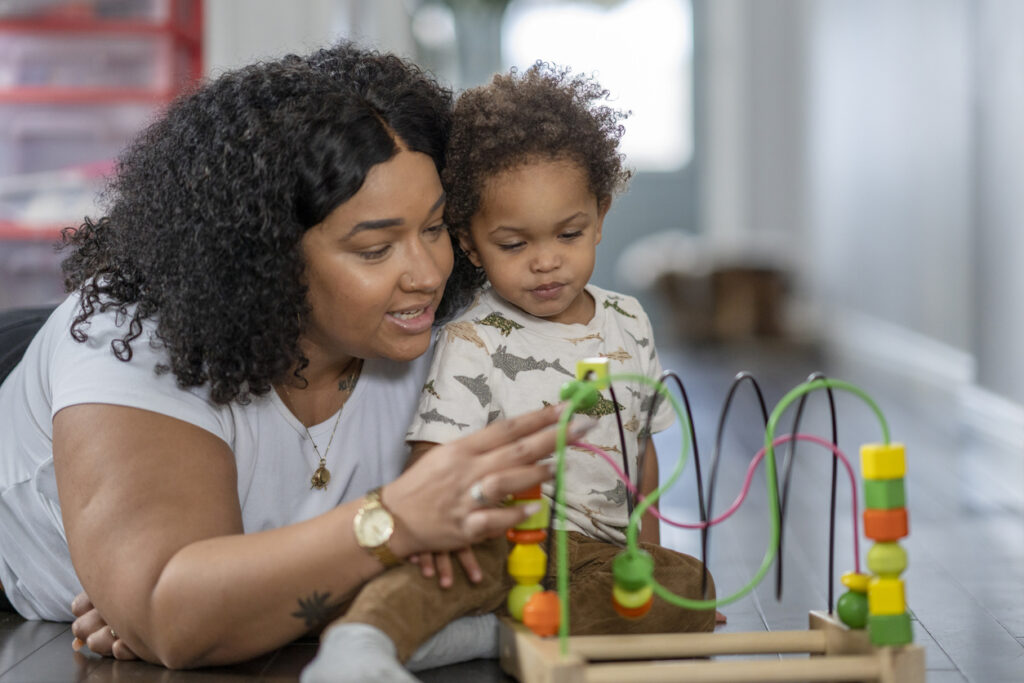
Communication is much broader than spoken words. Many autistic children communicate through gestures, facial expressions, body movement, vocalizations, or by showing and sharing objects. Others communicate through visuals, signs, or technology-based systems. These are not precursors to communication — they are communication.
When families begin recognizing these attempts, an important shift happens. Instead of seeing silence, they begin to see intention. Many children are communicating long before speech becomes accessible. Understanding communication in this broader way helps reduce pressure on children while strengthening connection between parents and caregivers.
Understanding “nonverbal” and nonspeaking autism
Many families encounter the term nonverbal autism, traditionally used to describe autistic individuals who do not use spoken language. Today, many clinicians and autistic self-advocates prefer the term nonspeaking.
While commonly used in the past, nonverbal has often been misunderstood to mean a child lacks understanding or intelligence. Because of this history, many professionals and autistic individuals have shifted toward language that better reflects lived experience. Nonspeaking recognizes that speech is only one way to communicate and does not define a child’s thoughts, abilities, or potential. Many nonspeaking autistic individuals understand far more than others assume and communicate meaningfully in ways beyond spoken words.
Language matters because expectations shape opportunities. When adults presume competence, children are more likely to receive communication supports that allow them to participate, learn, and express themselves.
When do autistic children start talking?
Autism does not follow a single developmental timeline. Some autistic children develop spoken language later than their peers, while others gain speech gradually or in bursts after periods of minimal verbal communication. Some children use both speech and alternative communication systems, while others may remain minimally speaking or nonspeaking.
Research shows that language development can continue well beyond early childhood. Rather than focusing only on when speech will emerge, it is often more helpful to ensure children have reliable ways to communicate throughout development.
Why some autistic children are not speaking
Many parents wonder whether their child simply needs more encouragement or practice. In most cases, speech differences are not related to motivation or effort.
Speech production requires complex coordination between motor planning, sensory processing, regulation, breathing, and muscle movement. Some autistic children experience motor speech differences, including apraxia, or broader cognitive-motor challenges that make producing spoken words difficult even when language understanding is strong.
From the outside, a child may appear quiet or disengaged. From the inside, speech may simply not yet be accessible. Recognizing this helps families move away from pressure-based expectations and toward supportive communication approaches.
How can I help my autistic child communicate?
Supporting communication development involves more than encouraging speech. Communication grows through connection, shared attention, emotional safety, and meaningful interaction.
Helpful strategies include following a child’s interests, responding to all communication attempts, modeling language naturally, and supporting regulation. Children learn communication through interaction — not performance demands.
Providing access to Augmentative and Alternative Communication (AAC) is also important. AAC may include speech-generating devices, communication applications, picture systems, or typing-based communication.
A common concern parents share is that AAC might prevent speech development. Research consistently shows the opposite. AAC supports language growth and often encourages spoken communication by reducing frustration and allowing children to experience successful communication.
Access to communication should never be delayed while waiting for speech.
Will my autistic child ever talk?
This is often the most emotional question families carry. Some autistic children do develop spoken language, while others primarily communicate through alternative methods throughout their lives.
Meaningful relationships, learning, autonomy, and quality of life do not depend solely on spoken speech. Communication — in any form — allows children to express preferences, emotions, humor, and identity.
As both an SLP and a parent, I have seen children’s personalities become more visible once they gain reliable ways to communicate, regardless of whether speech emerges.
Redefining communication progress
Communication progress is not measured only by vocabulary size. Growth may include initiating interaction, sharing enjoyment, requesting help, expressing boundaries, or participating socially and academically.
Children communicate most successfully when they feel regulated, understood, and respected. In my clinical work supporting autistic children and families, I often remind parents that communication development is not a race toward speech, but a process of building access, regulation, and connection over time.
Every child deserves to be heard
Many families begin by asking whether their child will talk. Over time, the question often becomes: How can my child communicate in ways that work best for them?
Autistic children — speaking or nonspeaking — have thoughts, emotions, humor, preferences, and identities worthy of expression. Our role as clinicians and caregivers is not to determine how communication should look, but to ensure communication is possible.
Every child deserves the opportunity to be understood, to participate, and to be heard. Early communication support — whether through speech, AAC, or both — helps ensure autistic children have access to connection, participation, and self-expression from the very beginning.
Sometimes, the most meaningful shift for families is realizing that communication is not something we wait for children to earn through speech. Connection begins the moment we learn to listen differently — to gestures, movement, regulation, expression, and presence.
When we expand how we recognize communication, many parents discover something profound: their child has been reaching out all along. Our role is not to rush children toward speaking, but to meet them where communication already exists and help their voice — in whatever form it takes — be heard.
Resources
American Speech-Language-Hearing Association (ASHA). (2023). Augmentative and alternative communication (AAC). https://www.asha.org/public/speech/disorders/aac/
Autistic Self Advocacy Network. (2020). Communication and accessibility. https:// autisticadvocacy.org/
National Joint Committee for the Communication Needs of Persons with Severe Disabilities. (2016). Communication bill of rights. https://www.asha.org/njc/communication-bill-of-rights/
Romski, M. A., & Sevcik, R. A. (2005). Augmentative communication and early intervention: Myths and realities. Infants & Young Children, 18(3), 174–185. https://doi.org/ 10.1097/00001163-200507000-00002
Tager-Flusberg, H., & Kasari, C. (2013). Minimally verbal school-aged children with autism spectrum disorder: The neglected end of the spectrum. Autism Research, 6(6), 468–478. https:// doi.org/10.1002/aur.1329