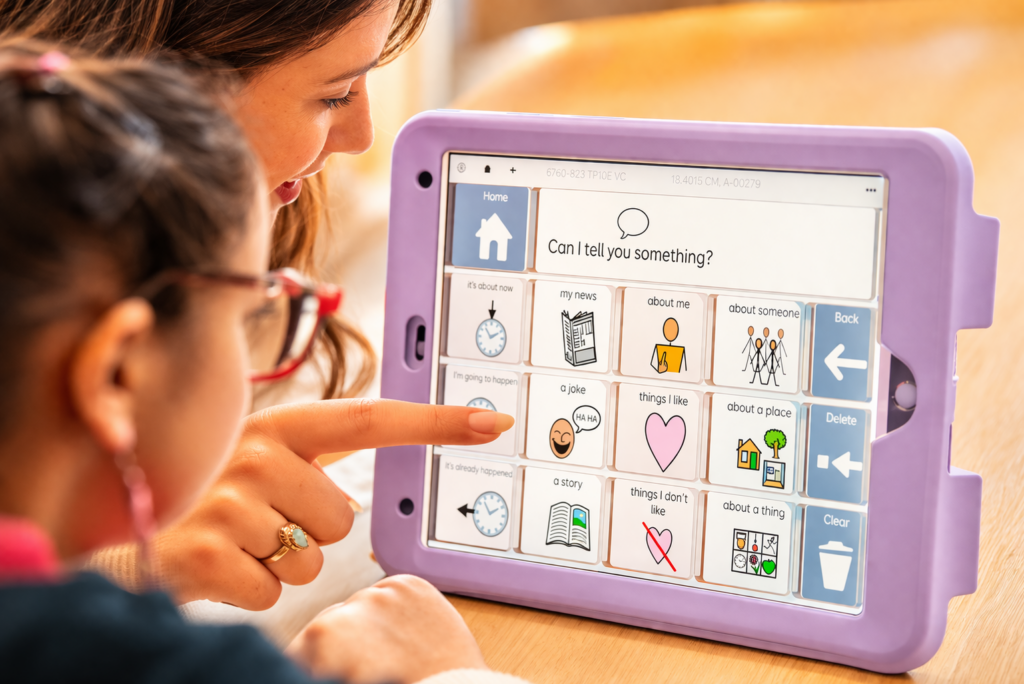


A neurodiversity-affirming guide for families
When families first hear the term AAC, many assume it is something used only when a child will never talk. Others worry that introducing AAC means giving up on speech or lowering expectations for their child’s future.
As a speech-language pathologist — and as a parent — I often reassure families that AAC is not a last resort. It is simply another way to support communication.
AAC stands for Augmentative and Alternative Communication, and at its core, AAC exists for one essential reason: everyone deserves a reliable way to communicate. For many children, AAC does not replace communication. It makes communication possible.
What is AAC?
Augmentative and Alternative Communication (AAC) refers to tools and strategies that support or replace spoken communication.
• Augmentative communication adds to speech.
• Alternative communication provides another way to communicate when speech is difficult or not accessible.
AAC can support individuals who are nonspeaking, minimally speaking, or whose speech may not consistently meet their communication needs.
Importantly, AAC is not just a device. AAC includes a wide range of communication methods that allow individuals to express thoughts, needs, emotions, and ideas in ways that work for their bodies and nervous systems.
Communication is not defined by speech alone.
Types of AAC
AAC exists along a spectrum from simple to high technology. No single system is inherently better than another — the goal is communication access.
No-Tech AAC
Communication that does not require tools, including:
• gestures
• facial expressions
• body movement
• pointing
• eye gaze
Many children begin communicating successfully using these natural methods.
Low-Tech AAC
Visual or physical supports such as:
• picture boards
• communication books
• visual schedules
• printed choice cards
These systems can be highly effective across environments.
High-Tech AAC
Electronic systems that generate speech, including:
• speech-generating devices
• tablet-based communication apps
• eye-gaze technology
High-tech AAC allows many children to communicate more independently in social and academic settings.
All forms of AAC are valid communication.
Who can benefit from AAC?
AAC can support many children, including those who:
• are nonspeaking or minimally speaking
• experience motor speech differences such as apraxia
• are difficult for unfamiliar listeners to understand
• become frustrated when communication breaks down
• understand more language than they can verbally express
Children do not need prerequisite skills before gaining access to AAC. They do not need to prove readiness or demonstrate specific abilities first. Communication access should come early — not after years of waiting to see whether speech develops. Providing AAC allows children to communicate now while continuing to support overall language development.
Will AAC stop my child from talking?
This is one of the most common and understandable concerns families share. Research consistently shows that AAC does not prevent speech development. In many cases, AAC supports spoken language growth.
When children have reliable ways to communicate, frustration often decreases and engagement increases. Communication becomes successful and rewarding rather than stressful or effortful. These positive experiences create more opportunities for language learning.
Some children develop spoken language alongside AAC, while others continue using AAC as their primary communication system. Both outcomes represent meaningful communication success.
AAC does not take speech away. It removes barriers so communication can grow.
AAC and presuming competence
A neurodiversity-affirming approach to AAC begins with presuming competence.
Many nonspeaking autistic individuals understand far more than others assume. When adults presume understanding and provide communication access, children are given opportunities to demonstrate knowledge, preferences, humor, and personality.
Communication differences are not reflections of intelligence. Often, the challenge lies not in thinking or understanding, but in the motor and sensory demands required for speech production.
AAC allows children to show us what they know rather than being limited by how easily speech comes to them.
When should AAC be introduced?
AAC can be introduced at any age, including early childhood.
Waiting to determine whether speech will emerge can unintentionally delay communication access during important developmental periods. Providing AAC early allows children to participate socially, express preferences, and build language foundations immediately.
Speech may develop over time — but communication should never be postponed while waiting for spoken language.
Working with a speech-language pathologist to support AAC
While AAC can and should be introduced early, partnering with a speech-language pathologist (SLP) can help families determine which communication supports best match their child’s strengths and needs.
AAC is not one-size-fits-all. Children differ in motor abilities, sensory preferences, regulation needs, and access skills. An SLP experienced in AAC can help evaluate how a child interacts with communication partners and tools to identify systems that are both accessible and sustainable across daily environments.
This process may include exploring picture-based systems, speech-generating devices, or communication applications designed for tablets. The goal is not to find the most advanced technology, but the system that allows a child to communicate comfortably and consistently.
An SLP can also guide families in learning how to model AAC naturally, integrate communication into everyday routines, and adjust systems as communication develops over time. AAC needs often evolve, and ongoing collaboration helps ensure communication tools continue supporting participation at home, school, and in the community.
AAC evaluation is not about determining whether a child is “ready.” It is about ensuring access.
Supporting AAC at home
Families play an essential role in AAC success. Helpful ways to support communication include:
• keeping AAC available throughout daily routines
• modeling communication naturally
• honoring all communication attempts
• allowing time for responses
• focusing on interaction rather than performance
Progress may look different from spoken language development. Growth may include initiating interaction, sharing enjoyment, making choices, or expressing emotions — all meaningful communication milestones.
AAC Is about access, not limitation
AAC is not a sign that something has failed. It is a tool that expands opportunity and participation.
Through AAC, children can:
• express needs and preferences
• build relationships
• participate in learning
• advocate for themselves
• share thoughts, humor, and identity
Communication is a human right. Every child deserves access to a way of being understood. Many families discover that once AAC is introduced, they are not replacing their child’s voice — they are finally hearing it.
When we expand how we recognize communication, we often realize something powerful: children have been communicating all along. Our role is not to rush speech, but to support communication in whatever form allows each child to connect, participate, and be heard.
Resources
American Speech-Language-Hearing Association (ASHA). (2023). Augmentative and alternative communication (AAC). https://www.asha.org/public/speech/disorders/aac/
Autistic Self Advocacy Network. (2020). Communication and accessibility. https://autisticadvocacy.org/
National Joint Committee for the Communication Needs of Persons with Severe Disabilities. (2016). Communication bill of rights. https://www.asha.org/njc/communication-bill-of-rights/
Romski, M. A., & Sevcik, R. A. (2005). Augmentative communication and early intervention: Myths and realities. Infants & Young Children, 18(3), 174–185. https://www.researchgate.net/publication/230852866_Augmentative_communication_and_early_intervention_Myths_and_realities