
A two-mile hike should not feel like wilderness navigation.
But with my son Mack, it does.
Not because he cannot walk two miles. He can. Not because he does not enjoy being outside. He does. Not because the trail itself was especially difficult. It was not.
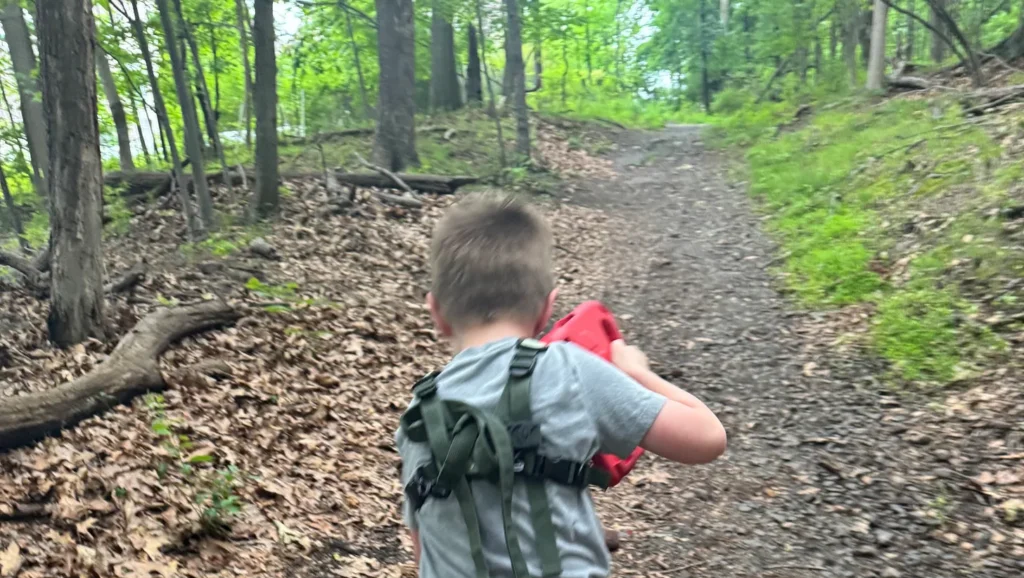
It was a new park. A reservation trail. Trees, gravel, shade, turns, other families, bikes passing, water somewhere nearby.
And from the moment we arrived, my alert system was on high.
Mack has profound, non-speaking autism. He also has a strong draw to water and a history of eloping, which means my body does not experience a trail the way another mother’s body might. I am not simply enjoying the trees. I am scanning the path ahead. I am listening for water. I am calculating distance. I am watching his pace, shoulders, hands, attention, and the angle of his body.
Other families may hike.
We navigate.
That is one of the things people often miss about autism caregiving. The ordinary is rarely ordinary. A walk in the woods is not just a walk in the woods. It is a moving risk assessment. It is a sensory calculation. It is a nervous-system experience.
On that trail, we passed maybe seven or ten other people: families, pairs, a couple of people riding bikes together. To them, passing another group was probably nothing. A small shift to the side. A quick hello. Maybe a smile.
For us, every pass was a full-body event.
Where is Mack’s body in space? Does he notice the bike? Will the sound startle him? Is he too close to the edge? Will he bolt? Will he reach? Will he stop? Will he move through this moment safely?
And then he did.
Again and again, he did.
He passed people. He tolerated the movement around him. He kept going. He stayed with us. He moved through a new place with his headphones on, his body working hard, his nervous system absorbing the world in real time.
To someone passing us, autism may have been visible for a second. They may have noticed the headphones. They may have sensed something different in our rhythm. They may have understood, vaguely, that autism was part of our orbit.
But they could not see the small victories that made that moment possible.
They could not see the years behind that trail.
Years of therapies. Years of sensory overwhelm. Years of practicing transitions. Years of learning safety. Years of trying again after places were too loud, too crowded, too unpredictable, too much. Years of helping a child move through a world that expects regulation from bodies and brains it does not always understand.
And if I am honest, I sometimes feel sadness when I see how easy it appears to be for other families.
They walk. They talk. Their children run ahead and come back. They pass bikes without calculation. They stand near water without every adult nerve ending in the family lighting up.
I know every family carries something.
But not every family carries this.
This is why small wins matter in autism care.
They are not sentimental. They are not consolation prizes. They are not what caregivers celebrate because there is nothing else to celebrate.
They are data.
They are evidence of effort, safety, connection, regulation, trust, and time.
For many autistic children, progress does not always arrive in the forms the world has been trained to recognize. It may not look like a traditional milestone. It may look like eye contact that lasts a little longer than yesterday. Trying a new food after years of refusal. Tolerating a transition that once felt impossible. Sitting through a concert. Walking through a parking lot. Passing a family on a trail. Staying safe near water. Remaining regulated for one more minute.
These are inchstones.
They are the moments too small for the usual measurement systems and too important for the world’s casual dismissal.
The danger is not only that other people miss them. Parents and caregivers can be conditioned to miss them too.
When you are constantly surrounded by typical timelines, you can begin to feel as if your child’s actual growth does not count unless it resembles someone else’s. The comparison is relentless. It lives in school hallways, pediatric waiting rooms, neighborhood conversations, family gatherings, playgrounds, hiking trails, and social media feeds. It appears in developmental charts and annual goals and in the casual ease with which other parents describe futures you once assumed would be yours.
No one has to mean harm for the harm to accumulate.
Over time, comparison can distort a caregiver’s vision. It can make her overlook the progress right in front of her because it does not look like the progress she was taught to expect.
That is why celebrating inchstones is not toxic positivity.
Toxic positivity denies grief. It rushes past pain. It insists everything is beautiful before anyone has been allowed to say what is hard.
That is not what small wins do.
Small wins allow grief and joy to occupy the same room.
They let a caregiver tell the truth: This is hard. This is not what I expected. This has cost me something. And still, my child is growing. Still, there is connection here. Still, something meaningful happened on that trail.
Regulation is one of those small wins.
We often talk about regulation as if it is a basic expectation, a minimum standard for public life. Children should sit still. Walk safely. Wait their turn. Use their words. Keep their bodies calm. Understand the room. Understand the trail. Understand the assignment.
But regulation is not basic for everyone.
For some children, regulation is work. Very hard work. Harder work than most can handle, which is why, most look away.
It is practice. It is discipline. It is repetition, support, trust, failure, recovery, and time.
And for their caregivers, it is often a full-body role: anticipating sound, preparing transitions, reading the environment, tracking exits, watching hands, noticing shifts in posture, protecting the dignity of the child while managing the expectations of everyone else.
The world may see a boy in headphones passing a family on a trail and assume nothing happened.
A mother knows everything happened.
She knows what did not happen. The elopement that did not happen. The panic that did not take over. The transition that did not collapse. The water that did not pull him away. The bike that did not overwhelm him. The moment that held. Every moment on that hike had my heart and soul vibrating this message to my brain.
This is the invisible labor beneath the inchstone.
And this is also why the caregiver’s small wins matter.
A mother cannot live indefinitely in high alert without tending to her own nervous system. Her own regulation is not selfish. It is part of the structure that helps her child remain safe, connected, and held.
Sometimes the small win belongs to the child.
Sometimes it belongs to the caregiver.
The walk she takes. The podcast she listens to. The breath she remembers before reacting. The text she sends to someone who understands. The moment she notices what went right before comparison steals it.
These are not luxuries.
They are part of caregiving.
A small win can carry a mother for days.
It can restore her faith in her child’s unfolding. It can remind her that the unseen labor matters. It can give her back a piece of herself that comparison tried to take.
The sacredness of small wins is not that they are small.
It is that they ask us to see differently.
To stop comparing disabled children to timelines that were not built with them in mind. To stop meeting a caregiver’s joy with polite silence. To stop treating regulation as basic compliance when, for some children, it is the work of years.
These moments matter because they restore something the world can easily take from families living with profound autism: the ability to recognize their children clearly.
Not as behind.
Not as less.
Not as almost.
But as whole.
And when a boy in headphones passes another family on a trail, stays near his mother, and keeps walking safely through the world, you do not need the world to clap.
You need it to understand that this, too, is progress.
You just need the world to understand that some of the most meaningful progress in a life is happening in moments small enough to be missed by everyone except the people who fought for them.
What matters is not whether anyone else notices.
What matters is that his parent does.