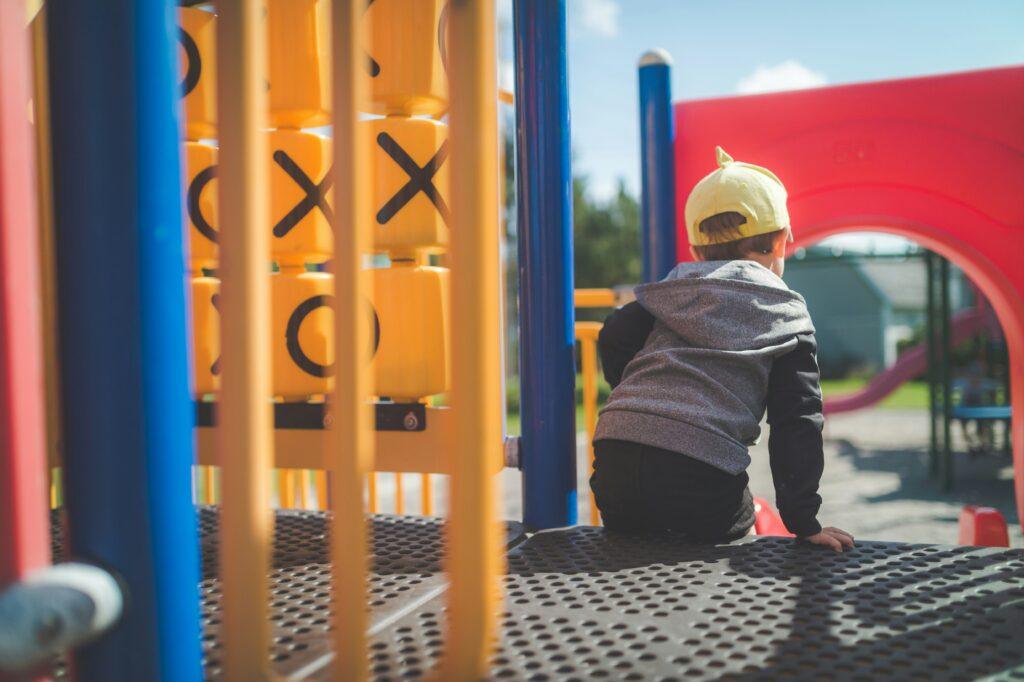


Picture the moment the recess bell rings. Most children race for the slides and swings. One child stays at the edge of the mulch because a wheelchair can’t roll across it. Another sits on a bench with hands over their ears, because the noise is too much. Recess is happening all around them, but not with them.
Play is not a break from learning. It is one of the main ways children learn, connect, and grow. That is why playgrounds should be built so every child can use them.
Play is how children learn
In a clinical report for the American Academy of Pediatrics, Yogman et al. (2018) explain that play “enhances brain structure and function and promotes executive function,” the skills children use to plan, focus, and manage big feelings. Play also buffers stress and builds the nurturing relationships children need to thrive.
The Centers for Disease Control and Prevention (CDC) reports that recess improves attention and concentration, helps students stay on task, reduces disruptive classroom behavior, and supports social and emotional growth, such as learning to share and negotiate.
Developmental milestones that grow on the playground
Many early childhood milestones are practiced at recess. The CDC’s developmental milestones for age 5, for example, include “follows rules or takes turns when playing games with other children” and “hops on one foot.”
| Area of development | What it looks like on the playground |
| Gross motor | Climbing, running, hopping, balancing, pumping legs on a swing |
| Fine motor | Gripping ladder rungs and monkey bars, scooping sand |
| Sensory processing | Swinging, spinning, and rocking to feel regulated and aware of their body |
| Social | Taking turns on the slide, joining a game, playing alongside a friend |
| Communication | Inviting someone to play, saying “my turn” with words, signs, or AAC |
| Emotional regulation | Waiting in line, coping when a game doesn’t go their way |
| Problem-solving | Planning a route across the structure, imaginative play |
Children reach milestones at different times and in different ways. But every child needs a place to practice. When a child can’t reach the equipment, or the space is too overwhelming, they miss thousands of small chances to build these skills alongside their peers.
There is no one right way to play
Children play in many ways, and all of them count. Autistic children and children with other developmental differences may play in ways that look different from what adults expect.
In interviews with 22 autistic adults, Pritchard-Rowe et al. (2024) found that solitary play served “an important recuperative function,” and many participants preferred parallel play, playing alongside others rather than in a shared game. The authors note that these findings “contrast with deficit-focused understandings of autistic play.”
A child might swing for twenty minutes because the rhythm is calming and joyful, collect leaves with deep focus, or share excitement through movement, sound, or a communication device. For children with substantial support needs, including children with profound autism, play can be a powerful source of joy, sensory connection, and self-expression. A well-designed playground makes it possible.
When playgrounds leave children out
About 1 in 6 children in the United States has a developmental disability, according to Zablotsky et al. (2019). Many more have physical, sensory, or communication differences. They have the same need to play and the same right to it.
The Americans with Disabilities Act sets minimum standards for play areas, such as accessible routes and firm surfacing, according to the U.S. Access Board. But these minimums focus mainly on physical access. They don’t fully address sensory needs or whether children can actually play together.
For parents, it can be hard to watch your child struggle on a playground that wasn’t built with them in mind. But the barrier is the design of the space, not your child.
What children learn when some kids can’t play
Playgrounds teach children who belongs. When a classmate always watches from the sidelines, children notice. Without anyone saying a word, they may learn that some kids are part of the game and others aren’t. They may never learn that the classmate who doesn’t speak has a great laugh and loves the tire swing.
Shared space alone isn’t always enough. In a review of 55 studies, Rademaker et al. (2020) found that “social participation does not always occur spontaneously” for students with disabilities, even in inclusive schools. Playgrounds designed for children to play together, not just near each other, make connection far more likely.
Accessible play also supports self-advocacy. On a playground built for them, a child can choose the swing, ask for a break in a quiet corner, or say “my turn” with a communication device. A child with substantial support needs can show what they enjoy through movement, sound, or expression. Each of those choices teaches a child, and their peers, that their preferences matter.
What makes a playground inclusive
An inclusive playground goes beyond the minimum so children of all abilities can play in the same space at the same time. Key features include:
- Smooth, firm surfacing and ramps
- Ground-level play, such as accessible swings, spinners, and roller slides
- Sensory elements like music panels, textures, and rocking equipment
- Quiet, shaded spaces for breaks from noise and crowds
- Communication boards for children who use AAC
These features benefit every child. A quiet corner helps an overwhelmed first-grader. A wide ramp helps a child with a broken leg.
How to find an accessible playground near you
Inclusive playgrounds are becoming more common, but they can still be hard to find. A few places to start:
- Online directories. The National Center on Health, Physical Activity and Disability (NCHPAD) keeps a list of tools for finding inclusive playgrounds, including directories from Let Kids Play, the Magical Bridge Foundation, and Shane’s Inspiration.
- Your local parks department. City and county parks websites often list accessibility features. If they don’t, call and ask what kind of surfacing, swings, and shade a playground has.
- Other families. Local parent groups and disability organizations often know which playgrounds work well in practice.
Before you go, look at photos or ask about the details that matter most for your child. Is the surface rubber or mulch? Is there fencing near a parking lot or street? Is there a quieter area, shade, or an accessible restroom nearby? Going at a less busy time, like a weekday morning, can make a first visit easier.
If there isn’t an inclusive playground near you, you can still ask for one. Parents and caregivers often start the conversations that lead to new or improved playgrounds in their communities.
Every child belongs at recess
Play is where children build the skills they carry into the classroom and into life. When we design playgrounds for every child, we make sure no child spends recess watching from the edge.
Resources
- Autistic Self Advocacy Network (ASAN): autistic-led self-advocacy and policy resources
- U.S. Access Board: Guide to Accessible Play Areas: federal accessibility standards for playgrounds
- NCHPAD: Find a Playground for Every Kid in Your Community: tools and directories for finding inclusive playgrounds